
Red Dot Sights and Night Vision Devices: A Complete Practical Guide
The combination of a red dot sight and a night vision device (NVD) is not simply two pieces of equipment used together. It is a standalone system with its own logic, limitations, and rules for effective use. Understanding the principles behind this system is what separates a genuine tactical advantage in the dark from potential position compromise.
How It Works: What Happens Inside the System
A red dot sight forms a reticle through collimation — the LED emits light that reflects off a specially coated lens and is projected to infinity. This is why the dot appears to "float" in space rather than being painted on the glass.
When using an NVD, the shooter observes this image through an image intensifier tube or a digital sensor. The reticle remains visible — but only if its brightness falls within the correct range. A dot that is too bright will bloom and wash out the intensifier; one that is too dim will disappear into the general image noise.
This method is known as passive aiming. The shooter uses no additional illumination, laser, or active emission of any kind. The system runs entirely on the sight's own LED and the NVD's amplification.
The key advantage of a red dot over classical iron sights in this setup is the absence of a rigid eye-to-optic-axis alignment requirement. When using a helmet-mounted NVD, head geometry is constantly shifting, and the unlimited eye relief of a red dot compensates for that instability.
Requirements for Correct NVD Compatibility
Not every red dot sight is suitable for passive aiming. The critical requirement is the presence of dedicated NV brightness levels, separated from the standard daytime range.
Why this matters: standard brightness settings, even at their minimum, frequently exceed the dynamic range of the NVD intensifier. NV mode reduces LED power to levels at which the reticle becomes visible to the intensifier without overloading it.
All current Holosun models support NV modes — this applies to both open emitter and closed emitter designs: AEMS, EPS, 507/508 series, SCS, and others.
Additional factors affecting NVD performance:
- Reticle size: a smaller dot (2 MOA) offers greater precision but is harder to acquire under time pressure. The combined dot-and-circle reticle (MRS) is a practical compromise
- Construction type: closed emitter produces fewer lateral reflections and reduces the overall signature
- Lens coating quality: poor optics generate more parasitic reflections, increasing the risk of position compromise
Position Compromise: A Real Threat and How to Reduce It
One of the least discussed but critically important issues is the visibility of the red dot sight through an NVD from the enemy's perspective.
The mechanism behind this is not the direct "glow-through" of the lens. It originates from LED emission leaking through the side surfaces of the housing and from reflections off internal optical elements. When the sight is aimed directly toward an observer using an NVD, the effect is significantly amplified — the observer may detect a characteristic glint.
Practical measures to reduce signature:
- Switching to NV mode — the absolute minimum; reduces LED power by a factor of tens
- Using closed emitter designs — smaller exposed surface area
- Selecting the minimum sufficient brightness — if the dot is visible, there is no reason to increase brightness
- Avoiding direct aiming toward other NVD users
Holographic sights (EOTech, Vortex AMG UH-1) have a lower back-signature compared to classic reflex sights. This is due to the design of the holographic system, where the laser forms the reticle image inside a sealed housing. However, they do not provide complete invisibility through NVDs either.
New Holosun Solutions: Integrated Laser Inside the Sight Body
A distinct category of devices combines the red dot sight with an integrated laser module, eliminating the need for a separate laser aiming device on the weapon.
Current models:
- Holosun ARO-EVO-DUAL — closed emitter red dot with integrated visible and IR lasers
- Holosun AEMS-EVO-DUAL — closed emitter red dot with the same laser block
Both models carry two laser types: a visible laser (for daytime use and target designation) and an infrared IR laser (exclusively for use with NVDs). The IR laser is invisible to the naked eye but clearly visible through any night vision device.
Practical advantage: the weapon remains compact, the number of independent mounting points and failure points is reduced, and day-to-day maintenance is simplified.
IR Lasers as a Standalone NVD Aiming Solution
Separately from red dot sights, there is a class of infrared laser aiming devices used as a primary or supplementary aiming method when an NVD is present.
Holosun Lineup for NVD Operations
Model | Laser Type | Features |
IR laser | Compact, for pistol platforms (also for carbines and rifles) | |
IR laser + visible laser | Combined module | |
Visible + IR laser + IR illuminator | Full tactical kit | |
IR laser + IR illuminator + visible laser + visible illuminator | High output | |
IR laser | Minimalist form factor | |
IR laser + visible laser (red / green) | IRIS Gen2 series | |
IR laser + IR illuminator + visible laser | IRIS Gen3 series | |
IR laser + IR illuminator + visible laser + visible illuminator | IRIS Gen4 series |
The advantage of an IR laser over passive aiming through a red dot is target acquisition speed without weapon-to-shoulder dependency. The shooter can engage a target without bringing the stock to the shoulder. The drawback is absolute NVD dependency — without a night vision device, the IR laser is completely unusable.
Red Dot + NVD vs. Holosun DRS: A System-Level Comparison
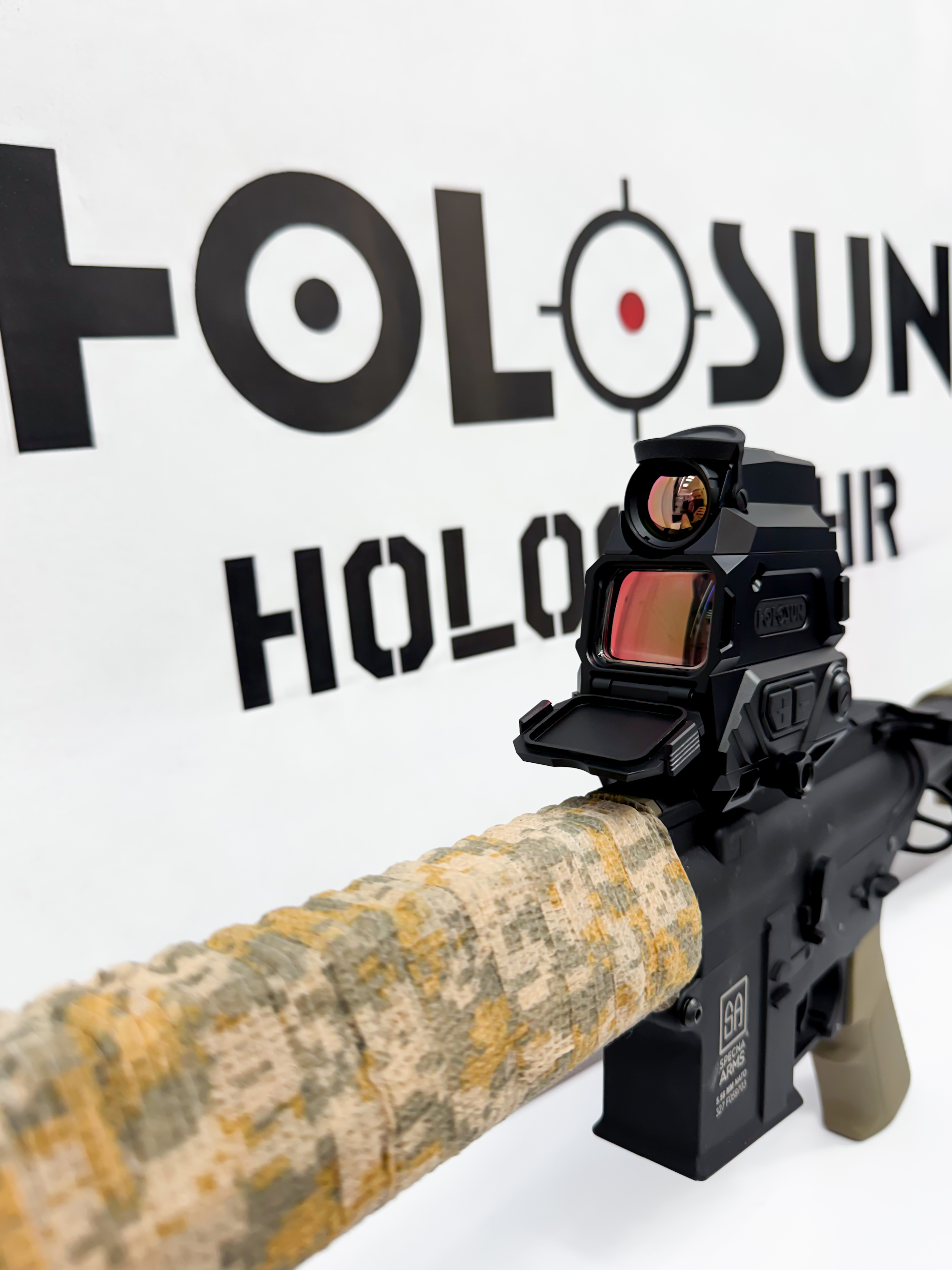
Holosun DRS NV (digital night channel) and DRS TH (thermal channel) are integrated solutions combining the functions of a sight and an observation device in one housing. They require no separate NVD and significantly simplify weapon configuration.
However, the fundamental limitation remains: the user sees the surrounding environment exclusively through the sight. This reduces situational awareness and complicates movement, reloading, and interaction with equipment — critical factors in tactical scenarios.
For hunting, where the shooter is mostly static and observing through a single sector, DRS is a practical and cost-effective solution. For tactical application, the classic combination of red dot + helmet-mounted NVD remains functionally superior.
Red Dot + NVD vs. Holosun DRS
Criterion | Red Dot + NVD | |
Situational awareness | Full — observation independent of weapon position | Limited to the sight's field of view |
Mobility | Maximum | Reduced |
Configuration | Requires a separate NVD | All-in-one housing |
Entry cost | High (NVD + red dot) | Lower |
Reloading and secondary tasks | Comfortable | Difficult |
Optimal application | Tactics, dynamic scenarios | Hunting, observation |
Common Mistakes When Using a Red Dot with an NVD
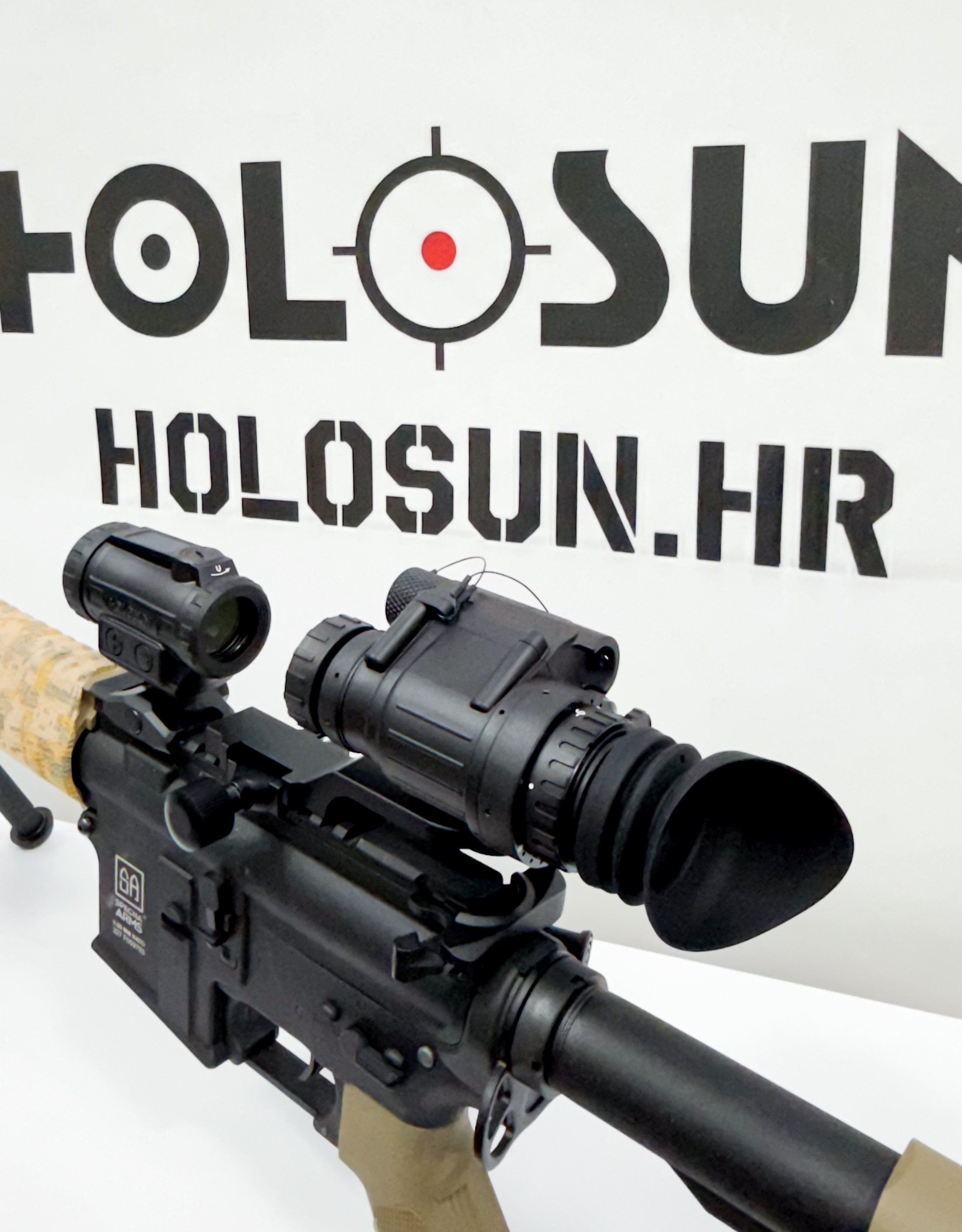
In the image Holosun ARO-EVO-RD2 + PVS14
- Reticle brightness set too high
The most common mistake, which negates all the advantages of the system. A bright dot blooms in the NVD and can serve as a position-compromise signal. Rule: NV mode on, brightness at the minimum sufficient level for confident reticle visibility. - Ignoring NV mode
Using standard brightness levels instead of NV levels guarantees discomfort and reduced performance. NV mode is not an option — it is a mandatory requirement for correct operation. - Incorrect mount height
A low mount creates an awkward geometry when using a helmet-mounted NVD. For most helmet-based systems, co-witness high or absolute co-witness high mounts are optimal. - Lack of dedicated training
The red dot + NVD system requires separate practice. The motor patterns for NVD operation differ substantially from daytime shooting — different depth of field, different aiming reference plane, different dot-acquisition speed. - Wrong equipment selection
A red dot without NV mode, an NVD with a narrow dynamic range, or incompatible mounts — any one of these errors degrades the effectiveness of the entire system. - Ignoring alternatives
In certain scenarios, an IR laser with an NVD provides faster target acquisition than passive aiming through a red dot. Thermal sights outperform NVDs in detecting targets in dense vegetation and fog. The choice of solution must match the specific scenario, not a default loadout.
Answers to Key Questions (FAQ)
Can any red dot sight be used with an NVD?
No. Dedicated NV brightness levels are required. Without them, the reticle either blooms the intensifier or disappears entirely. All current Holosun models include NV modes.
Is a red dot visible through an NVD from the enemy's side?
Yes, under certain conditions. The main factors are high LED brightness, open emitter construction, and direct aiming toward the observer. NV mode and closed emitter construction significantly reduce the signature.
What is more effective: a red dot or an IR laser when operating with an NVD?
Different tools for different tasks. IR laser — faster target acquisition without weapon-to-shoulder dependency. Red dot — passive aiming with no active emission, better precision. The optimal configuration often combines both.
Is special mounting hardware required?
Raised mounts are recommended for most helmet-mounted NVD systems. Standard mount height can create awkward geometry and slow down target acquisition.
Which is better: Holosun DRS or the classic combination?
Depends on the task. DRS — for hunting and observation. Red dot with helmet-mounted NVD — for tactical application and scenarios involving active movement.


Callback